
From Firefighting to Prevention: How Monthly Laravel Maintenance Saves You Thousands in Emergency Fixes
“We’ll fix it when it breaks.”
This reactive mindset is costing businesses 3-5x more than proactive maintenance while creating unnecessary stress, disrupting operations, and damaging customer relationships.
Last month, we received an urgent call from a company whose Laravel application was experiencing critical performance issues during their peak sales period. Their checkout process was timing out, costing them approximately $2,000 per hour in lost revenue.
The emergency response bill: $8,500 for a weekend debugging session.
The root cause: A database index that should have been added during routine monthly optimization. Total time to fix once identified: 15 minutes.
This scenario repeats itself across thousands of businesses every month. The pattern is always the same: defer routine maintenance, experience an emergency, pay premium rates to fix what could have been prevented.
Here’s why monthly Laravel maintenance isn’t just smart—it’s essential for any business that depends on its application.

The True Cost of Emergency Fixes
When your application breaks and you need immediate help, you’re not just paying for technical expertise—you’re paying emergency premiums across multiple dimensions.
Premium Hourly Rates
Standard maintenance: $100-150/hour during business hours Emergency response: $250-500/hour, often with minimum billing (4-8 hours)
Weekend and holiday emergencies can command even higher rates, with some specialists charging $750+/hour for immediate response.
Opportunity Cost of Downtime
While developers scramble to fix the issue, your application isn’t generating revenue:
- E-commerce: $100-500+ per hour depending on volume
- SaaS applications: Service credits, refunds, contract penalties
- Internal business tools: Employee productivity losses
- B2B platforms: Potential contract violations and penalties
For a modest e-commerce operation processing $2M annually, even 4 hours of downtime during peak periods can cost $5,000-10,000 in direct revenue loss.
Team Disruption and Context Switching
Emergency fixes don’t just affect the developers working on them:
- Your entire team stops planned work to assess impact
- Customer support handles angry user complaints
- Management gets pulled into crisis calls
- Marketing may need to address public concerns
- Sales deals get delayed or lost due to service issues
The hidden cost of context switching and disruption often exceeds the direct technical costs.
Customer Trust and Reputation Damage
Some costs are nearly impossible to quantify:
- Customers who experience errors during critical moments (checkout, data entry, important workflows) often don’t return
- Negative reviews and social media posts live forever
- Word-of-mouth damage in your industry
- Reduced conversion rates even after issues are resolved
- Longer sales cycles as prospects question reliability
One major incident can take months or years to recover from reputationally.
Stress and Burnout
The human cost of constant firefighting:
- Developer burnout from repeated emergency responses
- Leadership stress and decision fatigue
- Team morale damage from perpetual crisis mode
- Difficulty attracting and retaining top talent
- Increased turnover costs
Companies stuck in reactive mode lose their best people to organizations with more professional operations.
What Monthly Laravel Maintenance Actually Prevents
Professional monthly Laravel maintenance isn’t about making arbitrary changes—it’s a systematic approach to preventing predictable problems.
Performance Degradation
Applications naturally accumulate performance issues over time:
Database Optimization
- Query performance degrades as data volume grows
- Missing indexes slow down common operations
- Bloated tables need optimization
- Unnecessary data needs archival
Monthly maintenance includes reviewing slow query logs, analyzing database performance, and optimizing before users notice slowdowns.
Cache Management
- Cache configurations need adjustment as traffic patterns change
- Expired cache strategies cause unnecessary database hits
- Cache invalidation issues create stale data problems
Regular cache audits prevent performance issues and data inconsistency.
Code Optimization
- Memory leaks develop gradually
- Inefficient code paths get exercised under new usage patterns
- Third-party package updates introduce performance characteristics
- Asset optimization needs refresh as content grows
Proactive profiling catches these issues before they impact users.
Security Vulnerabilities
Security isn’t a one-time concern—it’s an ongoing process:
Framework and Dependency Updates As discussed in previous weeks, Laravel, PHP, and all dependencies need regular security patches. Monthly maintenance ensures these are applied systematically rather than reactively after exploitation.
Security Configuration Review
- Authentication mechanisms need regular audit
- Authorization rules may need adjustment
- API security configurations evolve
- SSL/TLS settings require updates
Monthly security reviews catch misconfigurations before attackers do.
Penetration Testing and Vulnerability Scanning Regular security scans identify new vulnerabilities introduced by code changes, configuration updates, or newly discovered exploits.
Data Integrity Issues
Small data problems become big data disasters without routine maintenance:
Backup Verification Many businesses have backups but have never tested restoration. Monthly maintenance includes:
- Backup completion verification
- Random restoration testing
- Backup retention policy review
- Disaster recovery procedure validation
Data Consistency Checks
- Orphaned records accumulate over time
- Referential integrity issues develop
- Data validation rules may need tightening
- Migration errors may go unnoticed
Regular data audits prevent corruption from spreading.
Technical Debt Accumulation
Deferred maintenance creates compounding technical debt:
Dependency Management
- Outdated packages become harder to upgrade over time
- Version conflicts emerge as dependencies diverge
- Security patches become impossible to apply cleanly
- Eventually, a full rewrite becomes cheaper than upgrading
Monthly updates keep dependencies current and compatible.
Code Quality
- “Quick fixes” accumulate without refactoring
- Test coverage degrades as features are rushed
- Documentation falls out of sync
- Code complexity increases
Regular code reviews and refactoring prevent decay.
Infrastructure Configuration
- Server configurations drift from documented states
- Temporary changes become permanent
- Resource allocations become suboptimal
- Monitoring gaps develop
Monthly infrastructure audits maintain consistency.
The Monthly Maintenance Checklist
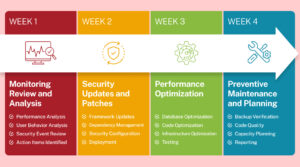
Professional Laravel maintenance follows a systematic monthly routine:
Week 1: Monitoring Review and Analysis
Performance Analysis
- Review application performance metrics
- Identify slow queries and endpoints
- Analyze error rates and patterns
- Assess resource utilization trends
User Behavior Analysis
- Review traffic patterns and growth
- Identify changing usage patterns
- Assess feature adoption
- Detect unusual activity
Security Event Review
- Analyze failed login attempts
- Review access logs for anomalies
- Check for vulnerability scan attempts
- Assess DDoS or abuse patterns
Action Items Identified: Create prioritized list of issues requiring attention
Week 2: Security Updates and Patches
Framework Updates
- Apply Laravel security patches
- Update PHP to latest stable version
- Review and apply server OS updates
- Update web server and database software
Dependency Management
- Run composer audit for vulnerabilities
- Update packages with security issues
- Test updated dependencies thoroughly
- Document all changes
Security Configuration
- Review and update firewall rules
- Rotate API keys and credentials
- Renew SSL certificates if needed
- Update security headers
Deployment: Apply all security updates to production after staging verification
Week 3: Performance Optimization
Database Optimization
- Analyze slow query logs
- Add or update indexes
- Optimize table structures
- Archive old data if appropriate
- Run database maintenance commands
Code Optimization
- Profile critical paths
- Optimize identified bottlenecks
- Review and update caching strategies
- Optimize asset delivery
Infrastructure Optimization
- Review resource utilization
- Adjust server configurations
- Optimize load balancer settings
- Review CDN performance
Testing: Verify optimizations improve performance without breaking functionality
Week 4: Preventive Maintenance and Planning
Backup Verification
- Verify all backups completed successfully
- Perform test restoration
- Review backup retention policy
- Document restoration procedures
Code Quality
- Review recent code changes
- Refactor problematic areas
- Update or add tests
- Update documentation
Capacity Planning
- Project resource needs
- Plan for growth
- Identify upgrade requirements
- Budget for future needs
Reporting: Document all activities and provide monthly report
Real-World Case Study: Preventive vs. Reactive
Let’s compare two identical businesses over 12 months:
Company A: Reactive Approach
Monthly Cost: $0 (no maintenance plan)
Year 1 Incidents:
- March: Database crash during peak traffic – $12,000 emergency recovery
- June: Security breach due to unpatched vulnerability – $45,000 remediation
- August: Performance issues during promotion – $8,500 emergency optimization
- November: SSL certificate expired – $3,000 emergency renewal and fixes
- December: Critical bug during holiday sales – $15,000 emergency fix
Total Year 1 Cost: $83,500 in emergencies Additional costs: Lost revenue, customer churn, reputation damage (estimated $50,000+) Team impact: High stress, burnout, two developers quit Actual total cost: $133,500+
Company B: Proactive Approach
Monthly maintenance: $3,499 × 12 = $41,988
Year 1 Activities:
- Monthly security patches applied
- Database optimized regularly
- Performance maintained proactively
- SSL certificates renewed automatically
- Code quality maintained
- 20 hours/month development time for improvements
Year 1 Incidents: Zero major incidents
Total Year 1 Cost: $41,988 Additional benefits:
- 240 hours of development for new features
- Improved performance over time
- Zero downtime
- Growing customer satisfaction
- Team morale high, zero turnover
Cost savings vs. Company A: $91,512+
This isn’t a hypothetical scenario—we see this pattern repeatedly with clients who come to us after experiencing the reactive approach.
The Psychology of Preventive Maintenance
Why do intelligent business owners defer maintenance despite clear financial benefits?
Present Bias
Human brains are wired to prioritize immediate concerns over future problems. A monthly maintenance bill feels tangible and present; a potential future emergency feels abstract and distant.
Optimism Bias
“It won’t happen to us” is a powerful cognitive bias. We see emergencies happen to others and somehow believe we’re immune.
Invisible Benefits
When maintenance prevents problems, nothing happens—and nothing happening is hard to celebrate or justify. Emergency fixes are visible and dramatic.
Budget Psychology
Maintenance is categorized as “expense.” Emergency fixes often come from different budget pools (emergency funds, insurance, etc.) and don’t feel like they “count” the same way.
Overcoming these biases requires reframing maintenance as insurance—you’re not spending money on nothing, you’re preventing catastrophic losses.
What Professional Maintenance Delivers Beyond Bug Fixes

Our Laravel Support & Maintenance Plan includes far more than just preventing emergencies:
20 Hours Monthly Development Time
Every month includes development hours for:
- New features and improvements
- UX enhancements
- Integration development
- Refactoring and optimization
- Custom functionality
This isn’t just maintenance—it’s continuous improvement.
Expert Strategic Guidance
Monthly check-ins provide:
- Architecture recommendations
- Technology stack advice
- Scaling guidance
- Best practice implementation
- Industry trend insights
You get a dedicated Laravel expert on your team without full-time hiring costs.
Complete Peace of Mind
Perhaps most valuable:
- Sleep through the night
- Focus on business growth
- Trust your application
- Impress customers with reliability
- Retain and attract top talent
The mental freedom from constant worry about potential issues has real economic value.
Compliance and Documentation
For businesses with regulatory requirements:
- Complete maintenance documentation
- Security audit trails
- Change management records
- Disaster recovery procedures
- Compliance reporting
This documentation is essential for audits, certifications, and due diligence.
Making the Transition from Reactive to Proactive
If you’re currently in firefighting mode, here’s how to transition:
Step 1: Comprehensive Audit (Week 1)
Assess current state:
- Security vulnerabilities
- Performance issues
- Technical debt
- Infrastructure configuration
- Backup and disaster recovery
Investment: One-time audit fee Outcome: Complete understanding of current risks and priorities
Step 2: Critical Issues Resolution (Weeks 2-4)
Address high-priority items:
- Critical security vulnerabilities
- Major performance issues
- Broken backup systems
- Obvious technical debt
Investment: May require additional development hours Outcome: Stable foundation for ongoing maintenance
Step 3: Establish Maintenance Routine (Month 2+)
Begin systematic monthly maintenance:
- Monitoring and analysis
- Security updates
- Performance optimization
- Preventive maintenance
Investment: Monthly maintenance plan Outcome: Continuous improvement and risk prevention
Step 4: Measure and Optimize (Ongoing)
Track results:
- Incident reduction
- Performance improvements
- Cost savings
- Team satisfaction
- Customer satisfaction
Outcome: Data-driven demonstration of maintenance value
The ROI of Preventive Maintenance
Let’s calculate the return on investment:
Monthly Investment: $3,499
Included Value:
- 24/7 monitoring: $1,500/month equivalent
- Security updates: $800/month equivalent
- Performance optimization: $1,200/month equivalent
- 20 hours development: $2,500/month value
- Expert consultation: $1,000/month value
- Peace of mind: Priceless
Total monthly value: $7,000+ for $3,499 investment
Annual ROI from emergency prevention:
- Prevents 2-3 emergencies averaging $15,000 each: $30,000-45,000 saved
- Eliminates downtime losses: $10,000-20,000 saved
- Prevents customer churn: $15,000-30,000 saved
- Reduces team stress and turnover: $20,000-40,000 saved
Conservative annual savings: $75,000-135,000 Annual investment: $41,988 Net benefit: $33,000-93,000+
The question isn’t whether you can afford maintenance—it’s whether you can afford not to have it.
Conclusion: Insurance You’ll Actually Use
Unlike traditional insurance that you hope never to need, Laravel maintenance insurance provides continuous value:
- Monthly development improves your application
- Regular optimization increases performance
- Security updates prevent breaches
- Monitoring catches issues early
- Expert guidance improves decisions
You’re not paying for something that might prevent a problem—you’re paying for continuous improvement while preventing catastrophic failures.
Ready to Stop Firefighting?
Our Laravel Support & Maintenance Plan ($3,499/month) includes:
- 24/7 comprehensive monitoring
- Monthly security updates and patches
- Performance optimization
- 20 hours monthly development time
- Emergency response (4-hour SLA)
- Complete documentation
- Expert strategic guidance
Schedule a free application audit to identify current risks and see exactly what monthly maintenance would include for your specific application.
Stop paying emergency premiums. Start preventing emergencies.
Your business deserves better than constant firefighting.
Related Resources:
- Why 24/7 Monitoring Prevents Costly Downtime
- The Hidden Costs of Skipping Regular Security Updates
- Performance Optimization: Making Your Laravel App Lightning Fast
Author Bio: Faheem Hasan | Secure Software Engineer | Laracore
With 15+ years of Laravel development experience, Faheem has helped dozens of companies transition from reactive firefighting to proactive maintenance, saving an average of $75,000+ annually in emergency costs while improving application reliability and team morale.

Faheem Hasan
Brings over 12+ years of specialized experience in web and Laravel application development, backed by a proven 99.9% reliability record across enterprise-grade environments. As a driving force behind Laracore’s vision, he leads with precision and innovation—delivering robust, high-performance Laravel maintenance and development solutions that meet the highest global standards.