

The Tuesday Morning That Revealed a $340,000 Approx. Problem
It started as a routine Tuesday morning standup. The CTO of a rapidly growing SaaS company asked a simple question: “When will the payment integration be ready?”
The lead developer hesitated. “Well… it’s been on the backlog for six weeks. Maybe two more weeks?”
“That’s what you said three weeks ago.”
The uncomfortable truth emerged: With a team stretched across maintenance, bug fixes, customer emergencies, and feature requests, nobody actually owned the payment integration. It wasn’t that the team was incompetent—they were brilliant. But with everyone responsible for everything, nothing got the focused attention it deserved.
The opportunity cost was staggering. Every week without the new payment processor meant:
- $12,000 approx. in lost transactions (processing fees were killing margins)
- Inability to expand to European markets (compliance requirements)
- Competitive disadvantage (rivals already offered the feature)
- Technical debt accumulating (old integration increasingly fragile)
Monthly cost of delay: around $85,000 Six weeks lost: $340,000 approx. in opportunity cost
This is the hidden tax of distributed accountability. And it’s a tax most growing companies pay without realizing it.
The 160-Hour Reality: One Month of Focused Dedication
What can actually be accomplished when someone owns a problem for an entire month? Let’s break down what 160 hours of dedicated Laravel development delivers when laser-focused on a single objective.
The Math:
- 40 hours per week × 4 weeks = 160 hours
- Dedicated focus (no context switching)
- Single point of accountability
- No competing priorities
- Domain expertise applied consistently
But raw hours tell only part of the story. The real power lies in what dedicated focus enables.
Real Transformations: What 160 Hours Built
Transformation 1: The Payment Integration That Unlocked around $2.4M
Company: B2B SaaS platform, around $8M ARR, 40 employees Pain Point: Legacy payment processor causing failed transactions, high fees, no European support What 160 Hours Delivered:
Week 1: Foundation & Architecture (40 hours)
- Comprehensive audit of current payment flow (8 hours)
- Architecture design for multi-provider support (12 hours)
- Database schema updates and migration planning (8 hours)
- API integration research and provider selection (8 hours)
- Security compliance review (GDPR, PCI DSS) (4 hours)
Week 2: Core Development (40 hours)
- Payment service abstraction layer (16 hours)
- Primary provider integration (Stripe Advanced) (12 hours)
- Webhook handling and event processing (8 hours)
- Error handling and retry logic (4 hours)
Week 3: Advanced Features & Testing (40 hours)
- Secondary provider integration (backup failover) (10 hours)
- Subscription management enhancements (8 hours)
- Invoice generation system (6 hours)
- Comprehensive test suite (unit, integration, E2E) (12 hours)
- Staging environment deployment and testing (4 hours)
Week 4: Launch & Monitoring (40 hours)
- Phased production rollout (10% → 50% → 100%) (12 hours)
- Real-time monitoring dashboard (8 hours)
- Documentation (developer, support, customer) (8 hours)
- Team training sessions (4 hours)
- Performance optimization and monitoring (8 hours)
Results:
- Transaction success rate: 94.3% → 99.7%
- Processing fees reduced 35% (around $42K annual savings)
- European expansion enabled (around $2.4M additional ARR Year 1)
- Failed payment recovery automated (captured around $18K in first month)
- Customer satisfaction increase (payment complaints down 87%)
ROI: $2.5M approx. value created for around $12K investment (208x return)

Transformation 2: The API Layer That Saved a Product Launch
Company: Mobile-first startup, pre-revenue, racing to launch
Pain Point: Existing REST API too slow for mobile, no offline support, poor error handling
What 160 Hours Delivered:
Week 1: Assessment & Strategy (40 hours)
- Current API performance profiling and bottleneck identification (10 hours)
- Mobile app requirements gathering with frontend team (6 hours)
- GraphQL vs REST evaluation and architecture decision (8 hours)
- Data modeling for offline-first architecture (10 hours)
- Security and authentication strategy (6 hours)
Week 2: Core GraphQL Implementation (40 hours)
- GraphQL schema design and type definitions (12 hours)
- Resolver development for core entities (14 hours)
- Database query optimization (N+1 problem elimination) (8 hours)
- Authentication and authorization middleware (6 hours)
Week 3: Advanced Features (40 hours)
- Real-time subscriptions for live updates (10 hours)
- Batch operations and data loader implementation (8 hours)
- Offline sync conflict resolution logic (12 hours)
- Cache layer (Redis) integration (6 hours)
- Error handling and logging infrastructure (4 hours)
Week 4: Polish & Performance (40 hours)
- Query complexity analysis and rate limiting (8 hours)
- Performance testing and optimization (10 hours)
- API documentation (GraphQL Playground, docs) (8 hours)
- Mobile team integration support (8 hours)
- Production deployment and monitoring setup (6 hours)
Results:
- API response time: 1,200ms → 180ms (85% improvement)
- Mobile app data usage reduced 60% (offline-first)
- Concurrent user capacity: 500 → 5,000+
- Launch deadline met (would have missed by 3 weeks otherwise)
- Investor demo success (led to $2M seed round)
ROI: Product launch enabled, around $2M funding secured
Transformation 3: The Security Overhaul That Prevented a Breach
Company: Healthcare SaaS, $15M ARR, HIPAA compliance required Pain Point: Failed security audit, 8 weeks to remediate or lose enterprise customers What 160 Hours Delivered:
Week 1: Security Audit Deep-Dive (40 hours)
- Comprehensive vulnerability assessment (12 hours)
- Compliance gap analysis (HIPAA, SOC 2) (10 hours)
- Threat modeling and risk prioritization (8 hours)
- Remediation roadmap with severity levels (6 hours)
- Stakeholder communication and timeline (4 hours)
Week 2: Critical Vulnerabilities (40 hours)
- SQL injection fixes across application (10 hours)
- XSS vulnerability remediation (8 hours)
- CSRF protection implementation (6 hours)
- Authentication security hardening (2FA, password policies) (10 hours)
- Session management improvements (6 hours)
Week 3: Data Protection & Compliance (40 hours)
- Database encryption at rest (8 hours)
- Encryption in transit (TLS/SSL hardening) (6 hours)
- Audit logging implementation (10 hours)
- Data retention and deletion policies (8 hours)
- Access control refinement (RBAC improvements) (8 hours)
Week 4: Infrastructure & Validation (40 hours)
- Infrastructure security hardening (10 hours)
- Dependency updates and vulnerability patches (8 hours)
- Security testing (penetration testing support) (8 hours)
- Compliance documentation updates (8 hours)
- Re-audit preparation and success (6 hours)
Results:
- All critical vulnerabilities remediated (12 of 12)
- High-priority issues resolved (18 of 18)
- Security audit: Failed → Passed with commendations
- $3.8M approx. in enterprise contracts retained
- New compliance certification enabled $1.2M approx. sales pipeline
ROI: around $5M+ in revenue protected and enabled
Transformation 4: The Performance Optimization That Scaled Revenue
Company: E-commerce platform, around $25M ARR, scaling challenges Pain Point: Application slowing under growth, losing customers to timeout errors What 160 Hours Delivered:
Week 1: Performance Analysis (40 hours)
- Application profiling and bottleneck identification (12 hours)
- Database query analysis (slow query log review) (10 hours)
- Frontend performance audit (8 hours)
- Infrastructure capacity planning (6 hours)
- Optimization strategy and prioritization (4 hours)
Week 2: Database Optimization (40 hours)
- Query optimization (N+1 queries, missing indexes) (14 hours)
- Database schema refinement (8 hours)
- Caching strategy implementation (Redis, query cache) (10 hours)
- Connection pooling optimization (4 hours)
- Read replica setup for reporting (4 hours)
Week 3: Application-Level Performance (40 hours)
- Eager loading implementation throughout app (10 hours)
- Asset optimization (compression, CDN) (8 hours)
- Queue implementation for heavy operations (10 hours)
- API response pagination and optimization (6 hours)
- Code-level performance improvements (6 hours)
Week 4: Scaling & Monitoring (40 hours)
- Horizontal scaling preparation (stateless sessions) (10 hours)
- Load balancing configuration (6 hours)
- Performance monitoring dashboard (8 hours)
- Automated scaling policies (6 hours)
- Stress testing and validation (10 hours)
Results:
- Page load time: 4.2s → 0.8s (81% faster)
- Server costs reduced 30% (better resource utilization)
- Checkout abandonment: 23% → 11% (around $840K annual revenue impact)
- Black Friday capacity: Handled 5x traffic without incident
- Customer satisfaction score: +18 points
ROI: around $900K+ annual revenue impact, $120K approx. infrastructure savings
The Pattern: What Makes 160 Hours Transformational
Looking across these transformations, five patterns emerge:
Pattern 1: Ownership Clarity
Problem: Distributed accountability = nobody accountable
Solution: One developer owns the entire problem for the entire month
Impact: Issues get resolved, not postponed
When everyone owns something, nobody owns it. A dedicated developer becomes the single point of accountability. Questions have answers. Decisions get made. Progress happens daily.
Pattern 2: Context Retention
Problem: Context switching costs 20-30% of productive time
Solution: Deep immersion in a single domain for 160 continuous hours
Impact: Exponentially faster problem-solving
Switching between tasks doesn’t just waste time-it destroys comprehension. A developer who spends a month in one codebase develops intuition that makes week 4 dramatically more productive than week 1.
The “expert effect” compounds:
- Week 1: Learning the domain, making foundational progress
- Week 2: Building on week 1, moving faster
- Week 3: Deep expertise, solving complex problems quickly
- Week 4: Operating at peak efficiency, handling edge cases
Pattern 3: Scope Completion
Problem: Projects stall at 80% complete, never crossing the finish line
Solution: Dedicated focus ensures complete delivery, not partial progress
Impact: Actual business value realized, not just activity
Half-built features create zero value. A payment integration that’s “90% done” still means lost revenue. Dedicated development ensures projects actually ship and deliver ROI.
Pattern 4: Quality Through Time
Problem: Rushed work creates technical debt and future bugs
Solution: Adequate time for testing, documentation, and proper implementation
Impact: Solutions that last years, not months
Quality can’t be rushed. With 160 hours, developers have time to:
- Write comprehensive tests
- Document decisions and implementations
- Handle edge cases properly
- Optimize for performance
- Consider security implications
This prevents the “quick fix that becomes a permanent problem” anti-pattern.
Pattern 5: Knowledge Transfer
Problem: Tribal knowledge trapped in individual developers
Solution: Documentation, training, and handoff as part of the 160 hours
Impact: Sustainable solutions that outlast individual contributors
Week 4 isn’t just about finishing-it’s about ensuring the solution can be maintained. Proper documentation, team training, and knowledge transfer mean the solution remains valuable long after the dedicated developer moves to the next challenge.
The Hidden Costs of Not Having Dedicated Development

Organizations often underestimate the true cost of distributed accountability:
Cost 1: Opportunity Cost of Delay
Every week a feature sits in backlog is a week of lost value:
- Revenue features delayed = money left on table
- Performance improvements postponed = customers churning
- Security fixes pending = risk accumulation
- Technical debt growing = future work getting harder
The payment integration example: $85K approx. per week in opportunity cost
Cost 2: The Context-Switching Tax
Research shows developers lose 20-30% of productive time to context switching:
- 40-hour week → 28-32 productive hours
- For a team of 5: 60 hours lost weekly
- Monthly: 240 hours lost to thrashing
240 hours of lost productivity = 1.5 dedicated developers worth of work
Cost 3: The Incomplete Project Graveyard
Projects started but never finished create negative value:
- Code written but not deployed = wasted investment
- Partial integrations = maintenance burden
- Team morale impact = reduced productivity
- Customer expectations set but unmet = trust erosion
Average cost per abandoned project: around $15K-$50K in sunk cost
Cost 4: The Bugs Nobody Owns Problem
When everyone owns bugs, nobody owns bugs:
- Bug sits in backlog for weeks/months
- Workarounds pile up instead of root cause fixes
- Customer support time increases
- Reputation damage compounds
Average cost per long-standing bug: around $5K-$25K in support and churn
Cost 5: The Technical Debt Accumulation
“Quick fixes” made by busy developers compound into mountains of debt:
- Each shortcut makes future changes harder
- Debt accumulates 15-20% annually in reactive orgs
- Eventually requires costly “big rewrite” projects
Technical debt cost: around $200K-$500K annually for mid-size apps
Total hidden cost for a typical organization: around $500K-$1.5M annually
The Dedicated Developer ROI Framework
Here’s how to calculate if dedicated development makes financial sense:
Step 1: Identify Your Highest-Value Backlog Item
What’s the one thing that, if completed this month, would create the most value?
- Revenue-generating feature?
- Performance improvement?
- Security remediation?
- Technical debt paydown?
Step 2: Calculate Opportunity Cost
What’s the monthly cost of NOT having this complete?
- Lost revenue?
- Customer churn?
- Competitive disadvantage?
- Team productivity drain?
Step 3: Estimate Completion Time
With dedicated focus (160 hours/month):
- Most features: 1-2 months
- Complex integrations: 2-3 months
- Major refactors: 3-4 months
Step 4: Calculate ROI
Investment: around $8K-$15K per month (dedicated Laravel developer) Return: Opportunity cost × months saved
Example:
- Feature value: $50K/month approx.
- Normal completion time: 4 months (distributed team)
- Dedicated completion time: 2 months
- Time saved: 2 months
- Value created: $100K approx.
- Investment: around $24K (2 months × $12K)
- ROI: 316%
When Dedicated Development Makes Most Sense
Not every situation requires dedicated development. Here’s when it’s the right choice:
Scenario 1: High-Value, Time-Sensitive Projects
- Revenue-impacting features with clear deadlines
- Competitive response requirements
- Market opportunity windows
- Compliance deadlines
Example: Payment integration to enable market expansion
Scenario 2: Complex Technical Initiatives
- Multi-week refactoring projects
- Major version upgrades
- Architecture improvements
- Performance optimization programs
Example: GraphQL API layer for mobile support
Scenario 3: Risk Mitigation Imperatives
- Security vulnerability remediation
- Compliance gap closure
- Data migration projects
- Disaster recovery implementation
Example: HIPAA compliance security overhaul
Scenario 4: Capacity Constraints
- Internal team stretched thin
- Key person dependency risks
- Expertise gaps
- Scaling challenges
Example: Startup racing to launch without adequate backend capacity
The First 30 Days: What to Expect
Organizations new to dedicated development often ask: “What will the first month look like?”
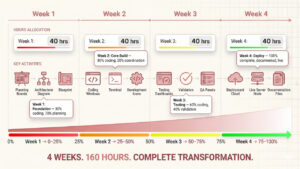
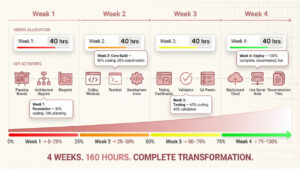
Week 1: Deep Dive & Foundation
- Comprehensive codebase audit
- Requirements clarification and scope definition
- Architecture planning and technical design
- Initial stakeholder alignment
- Quick wins (low-hanging fruit fixes)
Expect: 20-30% coding, 70-80% understanding and planning
Week 2: Core Implementation
- Primary functionality development
- Database changes and migrations
- API development
- Core business logic
Expect: 70-80% coding, 20-30% coordination
Week 3: Advanced Features & Testing
- Edge case handling
- Integration with existing systems
- Comprehensive testing
- Performance optimization
- Security hardening
Expect: 60% coding, 40% testing and validation
Week 4: Polish, Deploy, Transfer
- Documentation
- Team training
- Staged rollout
- Monitoring setup
- Knowledge transfer
Expect: 40% deployment/docs, 30% support, 30% next phase planning
Conclusion: The Accountability Revolution
The transformation from distributed chaos to dedicated focus isn’t just about hours—it’s about accountability, context, and completion.
160 hours of dedicated development delivers what 400 hours of distributed effort can’t:
- Actual completion, not perpetual progress
- Deep expertise, not surface-level understanding
- Sustainable solutions, not quick hacks
- Measurable ROI, not busy work
The companies in these case studies didn’t need more developers. They needed one developer who owned the problem completely for a full month.
That’s the power of 160 hours.
The question isn’t whether you can afford dedicated development.
It’s whether you can afford to keep paying the hidden tax of distributed accountability.

Faheem Hasan
Brings over 12+ years of specialized experience in web and Laravel application development, backed by a proven 99.9% reliability record across enterprise-grade environments. As a driving force behind Laracore’s vision, he leads with precision and innovation—delivering robust, high-performance Laravel maintenance and development solutions that meet the highest global standards.